
An open-source simulator for pressure, vacuum and temperature swing adsorption.
Build and run cycles in the browser, or use the same engine from Python and the command line.
Simulation 1 of 144
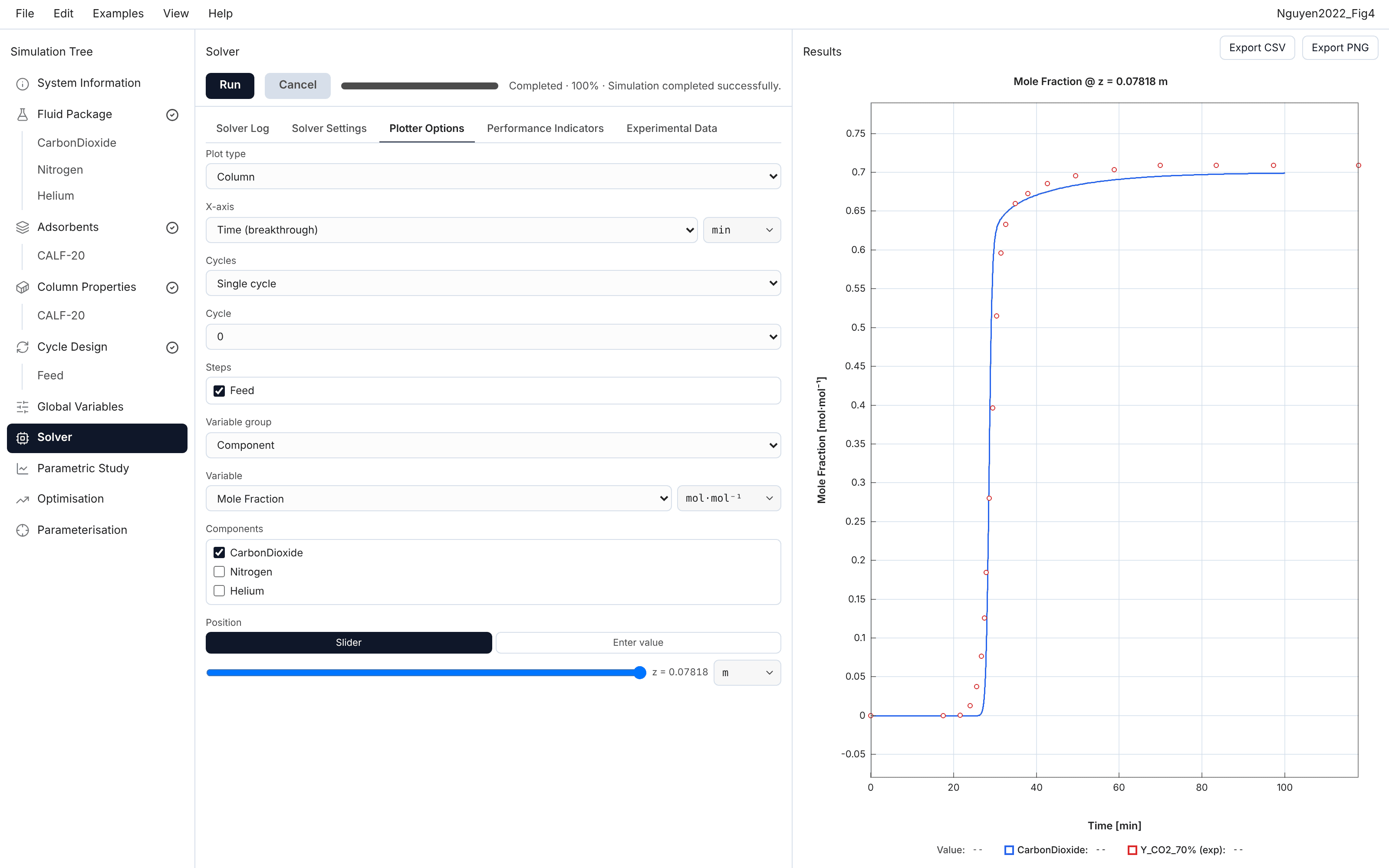
User interface
Set up the adsorbents, bed and cycle in the browser, run the simulation and compare the results with measured data.
Features
Non-isothermal
Gas, adsorbent and column wall energy balances.
PSA, VSA and TSA
Pressure, vacuum and temperature swing in one model.
Vacuum pumps and compressors
Power and specific energy for every pump.
Multi-bed cycles
Equalisation, reflux and purge between beds.
Acceleration to CSS
Extrapolation to cyclic steady state in fewer cycles.
Automatic KPI calculation
Purity, recovery, productivity and energy.
Optimisation
Multi-objective search with Pareto fronts.
Parametric sweep
Vary any parameter across a series of runs.
Parameterisation
Fit kinetic and heat-transfer parameters to data.
Multicomponent isotherms
Langmuir, Sips, Toth and more, competitive.
Adsorbent library
Curated adsorbent data, every value cited.
Python and command line
Script the same open-source engine.
Performance
The engine is C++ compiled to WebAssembly and runs in the browser, on your own machine. The chart shows how long each example takes to reach cyclic steady state from its initial conditions.
18.6 s
fastest example
22.6 s
median of 7 examples
41.8 s
slowest example
Seconds to cyclic steady state
Ward & Pini (2024), CO₂ VSA
18.6 s, 59 cycles
Vysyaraju et al. (2024), helium PSA
21.6 s, 34 cycles
Estupiñan Perez et al. (2019), CO₂ VSA
21.7 s, 55 cycles
Ferré et al. (2026), biogas PVSA
22.6 s, 52 cycles
Arora & Hasan (2021), O₂ PSA
27.1 s, 118 cycles
Arora & Hasan (2021), O₂ PVSA
36.3 s, 123 cycles
Nguyen et al. (2023), CO₂ VPSA
41.8 s, 28 cycles
Validation
The engine is tested against ten published studies; five are shown below. Each is an example in the engine repository and an automated test that computes the error against the paper. The validation results list every case, error and known cause.
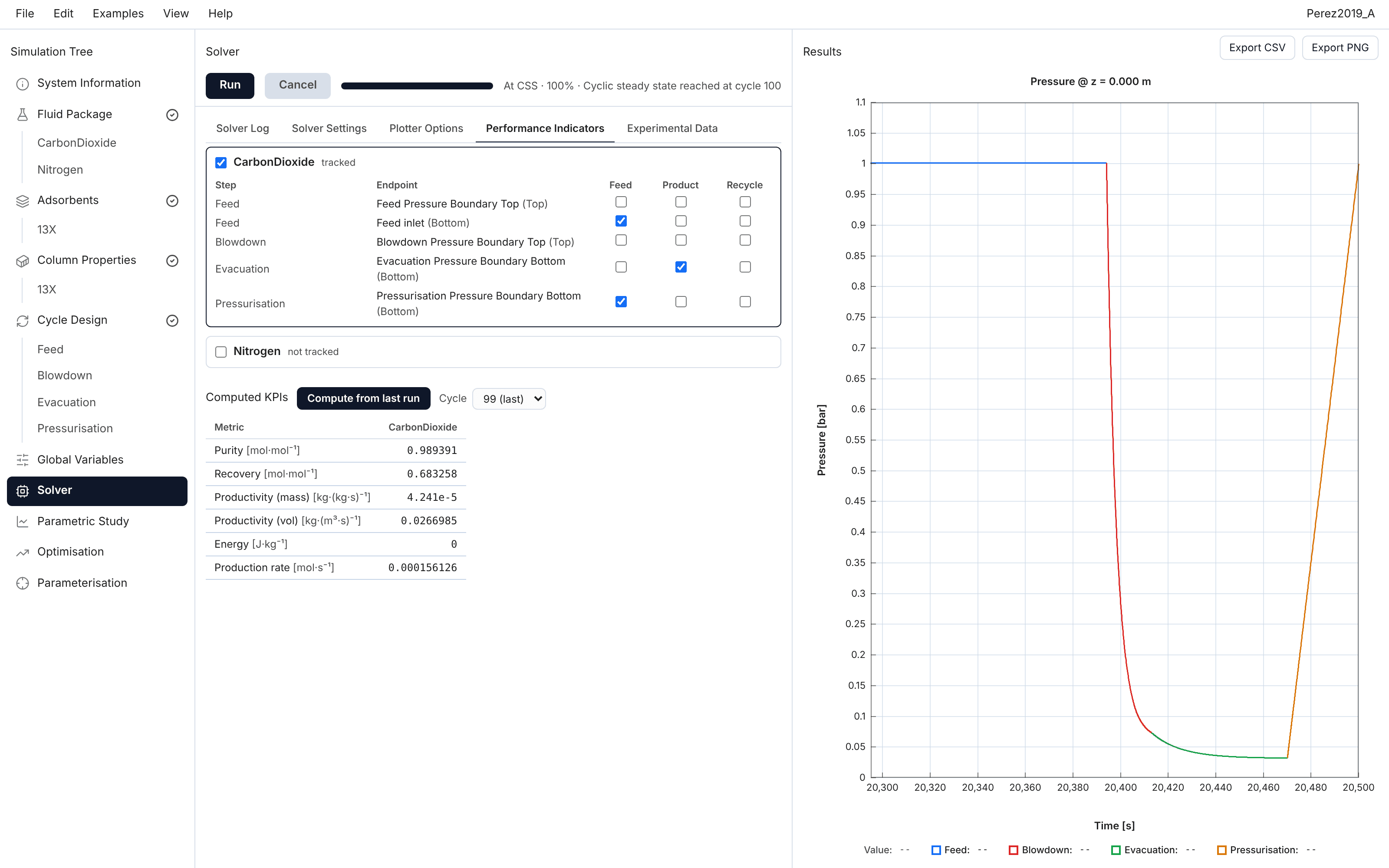
Estupiñan Perez, Sarkar & Rajendran (2019)
Separation and Purification Technology
Compared: CO₂ purity and recovery at cyclic steady state, six experiments

Estupiñan Perez, Sarkar & Rajendran (2019)
Separation and Purification Technology
Compared: CO₂ purity and recovery at cyclic steady state, six experiments
Get involved
Development is guided by a steering committee of researchers, process engineers and adsorbent developers from universities and industry. To join the committee or contribute, get in touch.
Roadmap
Which models, cycle features and adsorbents come next.
Review
New models, validation cases and adsorbent data.
Validation cases
Published or experimental cases to test the engine against.